Your Custom Text Here
For Others, For You

Countless articles and posts remind us of the the idea that how we carry ourselves affects how we feel about ourselves.
But this note is not about you or me.
Rather it’s about the people we care for and the people we surround ourselves with, because how we carry ourselves can affect more that just us; it affects those we are around.
We’re social animals, and the outward display of our mostly unconscious embodied emotions, movements, and intentions seems to have a tangible positive or negative effect on others.
Maybe it happens as you walk through the hall at work, maybe it’s in the classroom, maybe it’s in the way you embody your attention as you order your coffee, or maybe it’s at home with the person you love.
How specifically, but indirectly, can you influence a positive change in others through a change in the way you embody your own actions and intentions?
No Maintaining

It’s easy to think that once you’ve got it, you just need to maintain it.
But in reality there is no maintaining. There is only constant learning.
Your brain, your nervous system, your muscles and skeleton, your memories, your movement, your everything that makes up you - never takes a day off.
These aspects of you are always in a state of learning: One of growth and formation of new expression of yourself and movement; or continued solidification or adaptation of old ways you move, balance, posture yourself, and react.
Every new day, it’s up to each of us to re-let go of the idea of maintaining - because it’s not real. And instead, to re-direct our energy, attention, and influence over the process of growth and change.
Towards somewhere we want to go.
Conscious Attention and Kind Persistence

Photo by Ruth Troughton
Conscious Attention
The Alexander Technique is a conscious based technique.
It requires conscious attention and intention in movement, stillness, and action.
It does so to influence (not control) unconscious aspects of movement, ways we hold ourselves (posture), our responses (behaviours), and the way we sense and perceive ourselves and the environment.
As students, we learn to direct attention on specific things to help us observe and influence the connection between thought and physical responses or anticipation.
For example, we might place our attention on a series of intentions such as:
Allow my neck to be free of excess tension ....
To allow my head to move forwards and away from the top of my spine ...
To allow my back to lengthen and widen...
etc..
What many students don't realize is that the quality of how we consciously place attention matters.
Division Vs. Unification
To simplify things, you can imagine that the way you 'talk to yourself' either creates division between mind and body, or unification between thought and action. For instance
Division: Barking orders at yourself or begging to make specific muscle tensions release.
Unification: The use of kind, but persistent intention to influence your whole coordination; observing the physical changes in muscle tension and how they may relate to each other in the process.
It's all a game of attention, and thus the quality or kind of attention we use matters.
Kind Persistence
Although change can occur with both approaches (divisional or unification based ways of placing attention), one approach works far better than the other in getting the kind of results we want to show up in our Alexander Technique practice.
Kind Persistence requires both kindness is how you observe and 'speak' to yourself, and relentless persistence to do so in a constructive way. Kindness without persistence won't work - and persistence without kindness is divisional in it's approach, and thus less effective.
Change through the Alexander Technique requires both together - Kindness and persistence.
What approach did you use today?
Create A New Action
Mostly, we go about our days thinking and noticing very little about our movement - we do what feels natural until something bothers us. Then, we squirm around a bit until the uncomfortable feeling passes.
Sometimes though, we want or need to change our movement. The thing is that movement is largely an unconscious process full of habits, old perceptions, and challenges of balance and tensions. So in reality, a lifetime of habits doesn’t change overnight.
Still, there are many ways to change movement and get some kind of result. Sometimes good, sometimes not so good. But to create a completely new expression of movement is a real art.
What your brain/ central nervous system does all the time:
First, before we move, we unconsciously predict and sense: Ourselves, our movement to come, and the environment we move in.
Then, we move, and perceive our senses to see if they match what we thought would happen.
If what we sense doesn't match our prediction, then a new movement may have happened and our brain and nervous system learns.
Example:
You go to grab a carton of milk from the fridge. Your brain predicts it’s full and will require some more muscle tension to lift it up.
Turns out the carton was empty and wham! you lifted the carton way to fast with too much tension and hit the roof of the fridge. You now sense that this was too much power for how much you actually sense the carton weighs.
Your prediction didn’t match your senses so now your brain and nervous systems learns - and you use the appropriate amount of muscle tension to move the carton of milk smoothly out of the fridge.
A completely new movement is different that what we thought would happen. It’s a sensation that is different than our prediction. Otherwise it's something we already know, and it's not really new. So to create a truly new movement or action we have to be wrong about what we think will happen; wrong about what the movement will feel like.
The game is catch yourself making the guess unconsciously, then to make a decision to pause the guess… and let a new movement (or pattern of movement) show up on it's own.

Movement vs. Skill
When you learn the Alexander Technique, or become more advanced and apply it to 'work' on your coordination, the focus is often on specific movements; such as lifting an arm, or moving from sitting to standing.
It's easy to forget that the outcome of working with these specific movements is to:
Put the movements all together to do a skill
Apply the alexander technique in a broader way to influence an overall pattern of movements (a skill)

It can be easy to get lost working on the 'therapeutic' or 'cognitive' aspects within a specific activity; forgetting that the outcome still needs to make something happen (i.e do the skill).
Other students get lost in the overall pattern of movements (the skill), not taking enough care to refine the movement within the skill they want to improve.
Because of this, it can be helpful to get clear on what the difference is between a movement and a (motor) skill.
Movements are learned first
Movements are behavioural characteristics of specific limbs or parts
Movements are the building blocks of skills
Skills are voluntary goal-directed movements
Skills need head, torso, and/or limb movement to achieve an outcome
Different kinds of movements can be used to do the same skill, to achieve an outcome
So which area do you need to focus on today: The movement or the skill?
What movement are you going to apply the Alexander Technique to?
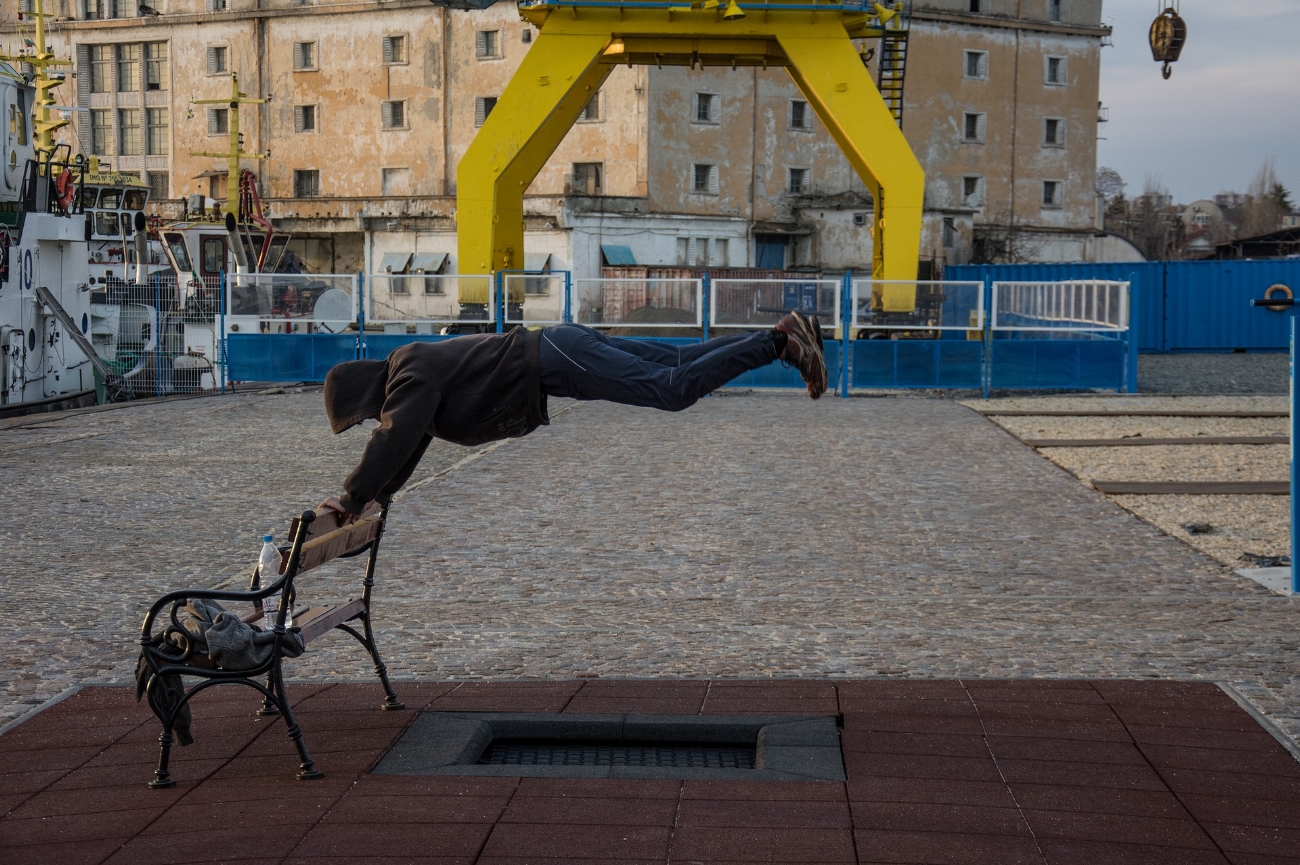
The Alexander Technique uses your movement (and postures) as a framework to enhance awareness and influence over the connection between thought and physical action.
With skill, you learn to use conscious intention as a way to create a positive change in your coordination; towards more ease in movement.
Students most often use their everyday movements (or utilitarian movement) as the main 'framework' to apply the technique to. This is great, because for the majority of your day we're usually just running the same old patterns of movement, posture (and behaviour); so to make even a small consistent change in everyday movement can really add up in your favour.
That said, the times when I've made the biggest leaps in my practice (and thus improvements in how I feel and move) have been when I also applied the Alexander Technique to more physically dynamic movements such as running, swimming, various types of exercise such as body weight training or yoga, hiking, sports, etc.. Usually for about 3-6 focused months for a single activity at a time.
Often, I find students shy away from applying the Alexander Technique to more dynamic activities for fear of 'doing it wrong'; but in doing so they miss out on the opportunity to discover how to 'do it right'. If done with learning and Alexander Technique principles as the primary focus, then 'the bigger the risk, the bigger the reward' seems to apply.
The Alexander Technique was created with movement in mind, and is designed so that all your movements and activities become a playground for self-understanding, exploration, and development.
So what do you want to apply it to?
What movements are you going to grow your practice and self through?
Alexander Technique Key Terms Reference Sheet

Here's download link for a 2 page reference sheet on key Alexander Technique principles/ jargon.
Most of these are not ‘scientific’ terms. Instead, they are terms that have been used within the Alexander Technique community for years to speed up communicating the ideas and concepts to students.
Alexander Technique Principles... are ingredients that make up the Alexander Technique. With practice you learn to understand and use them in new and creative ways to create the conditions for new movement and actions to show up. Have fun, and when lost, come back to principles.
Heads-up, this particular reference sheet has way too much info on it. It's recommend for students who have taken at least 10 lessons in the Alexander Technique, have some handle on what these terms mean from an experiential viewpoint. If you haven't had a chance to do these things yet there is other information on the blog that may be a better use of your time. If you have, enjoy!
Alexander Technique Research: Mini-Collection

Here's a collection of some research on the Alexander Technique.
Understanding the science behind the Alexander Technique is a real passion of mine, but if this seems to you like the most boring thing ever, no worries! Check out other posts blog, and feel free to get in touch about something you're curious about. If this is your cup of tea though, I hope this helps you better connect with some of what's out there. Read on and enjoy!
A FEW ALEXANDER TECHNIQUE STUDIES
- Chronic Neck Pain Alexander Technique Lessons or Acupuncture Sessions for Persons With Chronic Neck Pain: A Randomized Trial (2015)
- Medical and Health‐Related Conditions Evidence for the effectiveness of Alexander Technique lessons in medical and health-related conditions: a systematic review (2012)
- Chronic and Recurrent Back Pain Randomized controlled trial of Alexander technique lessons, exercise, and massage (ATEAM) for chronic and recurrent back pain (2007)
- Musicians and Performance Anxiety The Alexander Technique and musicians: a systematic review of controlled trials (2014)
- Parkinson's disease (2015) Lighten UpSpecific Postural Instructions Affect Axial Rigidity and Step Initiation in Patients With Parkinson’s Disease
- Parkinson's disease Randomized controlled trial of the Alexander technique forIdiopathic Parkinson's disease.Clinical rehabilitation (2002)
- Parkinson's disease Retention of skills learnt in Alexander technique lessons: 28 people with idiopathic Parkinson's disease (2005)
RESEARCH HAPPENING RIGHT NOW
- Alexander Technique with Physiotherapy for Back Pain Alexander technique and Supervised Physiotherapy Exercises in back pain (ASPEN): a four-group randomized feasibility trial
- Alexander Technique for Pain A service evaluation of Alexander Technique lessons for Pain Clinic Patients: An approach to pain management.
- Surgeons postural and ergonomic skills enhancement. A follow up study to...The impact of the Alexander Technique on Improving Posture and Surgical Ergonomics during minimally invasive surgery: pilot study.
- Knee osteoarthritis Pilot study of the effectiveness of Alexander Technique lessons for this population.
DISCOVERING HOW A.T WORKS
- Neuro-mechanical interference of posture on movement: evidence from Alexander technique teachers rising from a chair.
- Prolonged weight-shift and altered spinal coordination during sit-to-stand in practitioners of the Alexander Technique.
- Increased dynamic regulation of postural tone through Alexander Technique training.
- Improvement in automatic postural coordination following Alexander Technique lessons in a person with low back pain.
MORE
Society of Teachers of the Alexander Technique Research Page and Directory
Above is the website of the UK Alexander Technique governing body. I've linked you right to a nicely organized page that contains a lot of decently up to date research. It also includes some nice writing on the early history of 'science and the Alexander Technique'.
Alexander Studies
Above is a website being developed in collaboration with the Society of Teachers of the Alexander Technique. It aims to develop a platform for further publication and research opportunities to further understanding the Alexander Technique.
Lack of choice makes strain habitual


Awareness Through Movement is a book by Moshe Feldenkrais. There are many gems in it and deep, fundamental overlap with F.M. Alexander's early writing. Here's a short blurb from Moshe on habit for you to think over:
Lack of choice makes strain habitual (Pg. 84)
'As long as superfluous effort is invested in any action, man must throw up defences, must brace himself to great effort that is neither comfortable, pleasurable, nor desirable.'
'The lack of choice of whether to make an effort or not turns an action into a habit, and in the end nothing appears more natural than that to which he is accustomed, even if it is opposed to all reason or necessity'.
'Habit makes it easier to persist in any action, and for this reason it is extremely valuable in general. Nevertheless we can easily over indulge in habits until self-criticism is silenced and our ability to discern is diminished, which generally turns us into machines that act without thinking.'
Feldenkrais, M. (1972). Awareness through movement (Vol. 1977). New York: Harper & Row.
Free Resource - The Anatomy of Directing

The Anatomy of Directing (30min):
A nice, short, downloadable free e-book by Ted Dimon, an Alexander Technique teacher from NY.
It has several mini-movement and body mapping experiments an comes with a few pictures. You can read it and test out the experiments in each section a chapter at a time.
I think most is too advanced for brand new students; dependent on your experience/ background/ motivation-level. Still, a useful and worthwhile quick read.
Don't forget to actually try it out and figure out why (or why not) it's working for you. Alexander Technique knowledge without application is not the Alexander Technique.
Much thanks to Ted Dimon for sharing this work,